Research Data Netherlands (RDNL) awards the Dutch Data Prize biannually, recognising the work of researchers who make their research data, or research output that combines data and code/software, Findable, Accessible, Interoperable and Reusable (FAIR). The nominated researchers compete in three categories: Natural and Engineering Sciences, Social Sciences and Humanities, and Life Sciences and Health.
This year’s finalists include two WORMVACS2.0 researchers – Koen Stam and Floor de Weijer from the Leiden University Medical Center – nominated for their work on beFAIR: from FAIR clinical trial data to open immune profiles. The submission included the beFAIR pipeline, the dashboard, and an immunological dataset (available on the dashboard under the Dutch Data Prize tab).
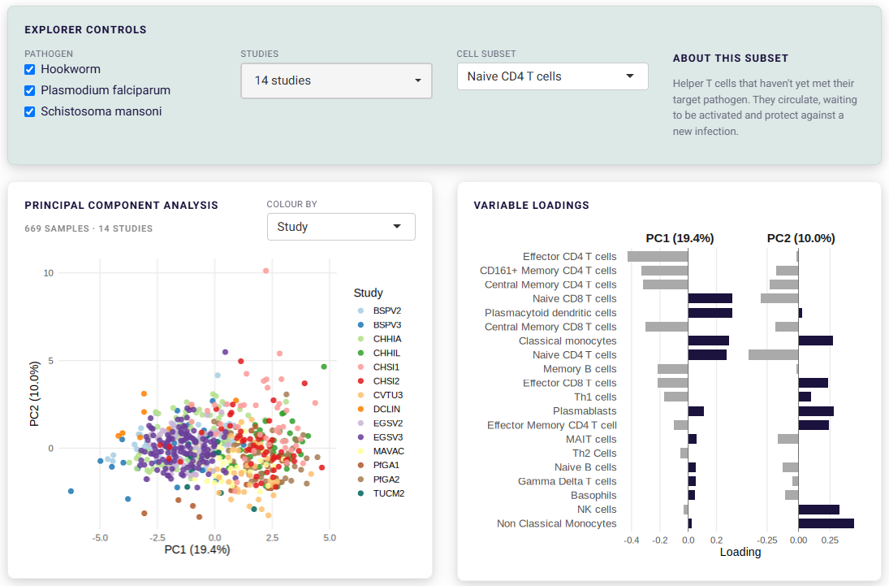
A screenshot from the dashboard.
Supporting others in making their data FAIR
By working in line with the FAIR principles, researchers make sure that the data they collect can be found, accessed, operated, and reused by computational systems, which researchers increasingly use to store and analyse data. beFAIR is built to help with exactly that. It is an open-source R pipeline that takes data from different sources, harmonises it, and records how every value was processed. Any research group can apply it to their own data, whatever the disease or data type. The aim is not only to make one dataset FAIR, but to offer an approach that others can replicate.
To develop and test this approach, the team started with data from their own research: clinical trials of hookworm, Schistosoma mansoni and Plasmodium falciparum (malaria) from the WORMVACS2.0, BASEMALVAC and HypoVax Global consortia. These trials link clinical and laboratory data from several sites, including partners in endemic countries. That makes them a demanding test case for an approach meant to work for other data too.
The data related to WORMVACS2.0 cover human Schistosoma mansoni and hookworm infection trials, including those from endemic areas. Analysing this data shows differences in the immune profiles of participants from non-endemic and endemic regions, a key consideration in developing effective vaccines against parasitic infections.
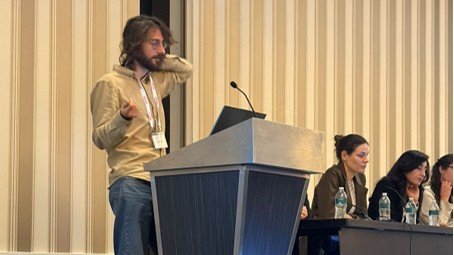
Koen Stam presenting at a conference.
The nominees hope that the dataset example and the FAIRification tool can help other researchers make their data truly FAIR and ensure it can be viewed and analysed worldwide. This matters because clinical trials are costly and therefore have a small number of participants. Data that can be reused gets the most out of every trial and avoids repeating research that has already been done. For infectious diseases that mainly affect low- and middle-income countries, it also means researchers in those countries can access and build on data collected in their own communities. Combining data from different studies and regions answers questions no single trial can, such as why a vaccine works in one population but not another.
Ensuring project data is available long-term
Research behind complex goals, such as developing new vaccines, requires a diverse group of experts. In addition to the essential work of researchers conducting infection trials and analysing data, it is key to think deeply about how the findings are stored. By making data FAIR, projects such as WORMVACS2.0 will live beyond the project's end and can be viewed and used by other researchers in the years to come.
A specific challenge faced by the nominees - Koen Stam and Floor de Weijer – was to ensure that their work is in line with the European Health Data Space Regulation, which aims to establish a common framework for the use and exchange of electronic health data across the EU. For beFAIR, this meant ensuring the data is well described and traceable from the start. Every dataset comes with clear metadata, published through a FAIR Data Point, so others can find out what data exists without seeing the sensitive data itself. The pipeline also logs every processing step, so it is always clear where a value came from and how it was changed. This prepares the data to be shared under the EHDS rules, where researchers request access to health data through a formal permit process.
Up next: expanding access and presenting beFAIR
The team behind beFAIR just received additional funding to publish beFAIR on CRAN, the official repository for R software. This will include clear documentation, tutorials and a permanent citation for researchers to download and make their data FAIR.
To make a case for the project, Koen Stam will pitch the project to the Dutch Data Prize’s selection committee on 3 December, and the winners in the three categories will be announced later that day.
A presentation to a wider audience is also planned with a workshop on 17 January, where participants will learn how to use beFAIR during the FAIR Fellowship Symposium.
In addition to the EU (through WORMVACS2.0), the beFAIR work is financed by the National Institutes of Health (through the BaseMalVac project), Hypovax Global and the Gates Foundation.