
Authors: Inocência Cuamba, Rebeca Santano, Berta Grau-Pujol, Marta Vidal, Ruth Aguilar, Anélsio Cossa, Chenjerai Jairoce, Rojelio Mejia, Augusto Nhabomba, Jose Muñoz, Gemma Moncunill & Carlota Dobaño
Title: Helminth coinfections mitigate clinical, parasitological, and immune outcomes in Mozambican children with malaria
What is this publication about?
This publication presents the results of a study done among malaria-positive children (2-10 years old) in Mozambique. Researchers compared the malaria outcomes and immune responses between the children who only tested positive for malaria and those who, in addition to that, also tested positive for soil-transmitted parasitic worms (helminths).
They found that coinfection was associated with lower Plasmodium falciparum parasite density, reduced fever and inflammation, and an enhanced antibody response to the parasite.
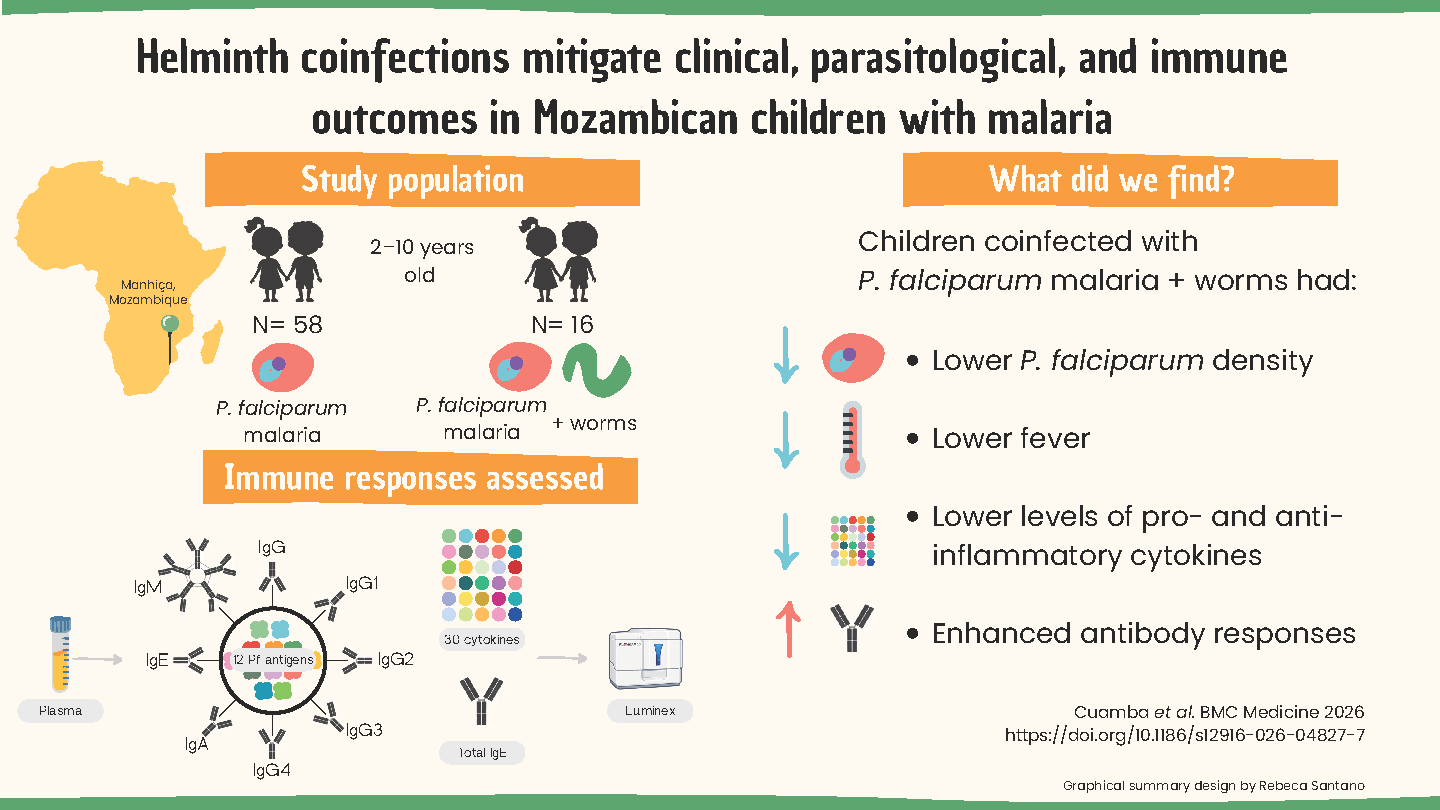
Graphical abstract of the study’s findings by Dr Rebeca Santano.
Why is it important?
Infections such as malaria and parasitic worm infections continue to have profound effects on public health, with effects mainly concentrated in low- and middle-income countries. Despite coinfections being common, data on their effects are still limited or inconclusive.
New research on the effects of coinfection can eventually lead to new or improved preventive and treatment methods and ultimately strengthen global health.
How can this make a difference?
The findings suggest a potential protective effect of helminth infection on malaria-related outcomes. This insight could affect public health interventions, for example, by considering malaria testing or preventive treatment when people receive treatment for parasitic worm infections to prevent the growth of P. falciparum parasites. Such integrated approaches could result in positive health outcomes in regions where both infections are common.
More generally, these new findings on the immune system’s response to coinfection will advance knowledge of human immunology and support ongoing research aimed at developing new drugs or vaccines.